Atomic Energy Commission General Advisory Committee
American PrometheusThe Atomic Energy Commission General Advisory Committee was the scientific advisory body established to assist the commissioners of the United States Atomic Energy Commission. Under J. Robert Oppenheimer’s chairmanship, it became a place where technical judgment, moral argument, and competing ideas about national security met. Its 1949 opposition to a crash program for the hydrogen bomb was its defining intervention: the committee argued that a weapon capable of destroying vast areas would threaten civilians, damage American interests, and intensify the arms race rather than provide a dependable form of security.
Mandate and membership
Following Congress’s passage of the McMahon Act on August 1, President Harry S. Truman appointed David Lilienthal chairman of the newly created United States Atomic Energy Commission. The law required the commission to establish a General Advisory Committee to assist its commissioners. Truman appointed Oppenheimer despite his dislike of him, following recommendations from several advisers. The committee brought together scientists with experience in atomic research and public service, including Isidor Isaac Rabi, Enrico Fermi, James B. Conant, Cyril Stanley Smith, and Lee DuBridge, alongside other scientific and technical advisers.
The members chose their own chair. A news report mistakenly suggested Conant would receive the position, prompting Katherine (Kitty) Oppenheimer to ask her husband why he had not been named. He assured her it was not a major issue. In fact, DuBridge and Rabi were quietly working in Oppenheimer’s favor. When the committee held its first formal meeting in early January 1947, a snowstorm had delayed Oppenheimer’s arrival; he reached the meeting to find that his colleagues had unanimously elected him chairman.
The advisory role did not mean the committee controlled government policy. Its task was to counsel the commissioners, while decisions remained with the commission and, on matters of military use, the White House. Oppenheimer’s work also took place within a system of classification: at his office at the Institute for Advanced Study, a locked safe held classified documents for his committee duties, with armed guards posted beside it around the clock. The arrangement joined a scientific advisory body to the security apparatus surrounding atomic policy.
Oppenheimer’s chairmanship and changing outlook
When Oppenheimer became chairman, he was increasingly disillusioned with both the Soviet and American positions on international atomic control. In conversations with Hans Bethe in January 1947, he said he had given up hope that the Soviet Union would accept a workable plan. He regarded its proposal to ban the bomb as one that would leave the United States without the weapon he believed could prevent Soviet expansion into Western Europe. His outlook was moving away from the internationalist hopes he had held earlier, as reports of Soviet espionage and his understanding of Soviet policy further undermined his confidence in cooperation.
That change affected his use of the chair. In March 1947, after Dean Acheson previewed the emerging Truman Doctrine and told him that the United States was entering an adversarial relationship with the Soviet Union, Oppenheimer advised Frederick Osborn that the United States should withdraw from the United Nations atomic-energy negotiations. He believed the Soviets would not accept a workable plan. The shift did not end his concern about an arms race; rather, it changed his judgment about the prospects for negotiating one away. His committee leadership thus developed amid the hardening international conflict, not outside it.
The 1949 hydrogen-bomb deliberations
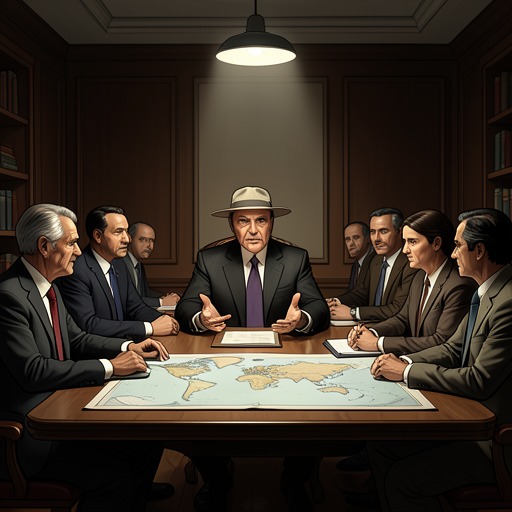
The committee’s most consequential debate began at two o’clock on October 28, 1949, when Oppenheimer convened its eighteenth meeting in the Atomic Energy Commission’s conference room on Constitution Avenue. Over three days, committee members heard expert witnesses, including George Kennan and General Omar Bradley, and considered the merits of the proposed hydrogen bomb, or Super. Commissioners Lewis Strauss, Gordon Dean, and David Lilienthal attended some sessions. The members knew that the Truman administration faced pressure to respond forcefully to the Soviet Union’s successful atomic test. Oppenheimer nevertheless held back his own view until others had spoken. Lee DuBridge later recalled that the members went around the table and that their views were negative.
The committee’s opposition was not simply a technical assessment of whether the weapon could be built. Oppenheimer and the majority considered what its scale would mean for military policy and human life. A Hiroshima-sized atomic bomb had a yield of 15,000 tons of TNT; a feasible thermonuclear bomb might reach 100 million tons and destroy 150 to 1,000 square miles or more. In the committee’s analysis, a legitimate military target would be too small to justify such a weapon’s destructive reach. Its report warned that a Super might become a weapon of genocide and that possessing one could damage American security by persuading other nations that the United States contemplated mass destruction of civilian populations.
The majority also challenged the argument that the United States had to build the weapon to deter the Soviet Union. If the Soviet Union developed a Super, the committee reasoned, the United States’ existing stock of atomic bombs could make retaliation comparably effective. Building an American Super, therefore, would not necessarily deter Soviet development. The members hoped that refusing to produce the weapon might instead leave room to reopen arms-control negotiations. Oppenheimer wrote for the majority that mankind would be better off without a demonstration of the weapon’s feasibility.
The report proposed an alternative to accumulating ever more destructive weapons: increase the production of fissionable materials for smaller tactical atomic weapons and strengthen conventional forces in Western Europe. The committee argued that such forces could provide a more credible deterrent to a Soviet invasion than a city-destroying Super. This approach anticipated the idea of nuclear sufficiency: an arsenal sized for defined military purposes rather than expanded without limit through a competition in stockpiles. Its rationale carried its own risk, however. Tactical nuclear weapons might be more usable in a battlefield conflict, bringing nuclear arms into military operations rather than keeping them as instruments of general deterrence.
Decision and political consequences
On November 9, 1949, the Atomic Energy Commission’s commissioners voted three to two to endorse the committee’s recommendations. David Lilienthal, Pike, and Smith opposed a crash program; Strauss and Dean supported it. Oppenheimer took satisfaction in the result, though his secretary Katherine Russell predicted that the report would cause him trouble. He initially thought the fight had been won, but the vote did not settle the national debate. Supporters of the hydrogen bomb mounted a counteroffensive, and officials who regarded war with the Soviet Union as inevitable treated the committee’s caution as dangerous. The dispute exposed a deep division between advocates of arms control and advocates of rapid weapons expansion.
The committee’s influence also extended beyond its report. Oppenheimer’s policy work continued through later strategic studies. As a principal author of Chapter Five of the 1951 Project Vista report, he supported giving tactical weapons a role in defending Western Europe and argued that the United States should consider a policy of no first use. These positions were consistent with his search for alternatives to an Air Force strategy based on a massive initial assault, but they also raised the possibility that battlefield nuclear weapons would actually be used. The shift from opposing a Super to supporting tactical weapons illustrates the difficult boundary between limiting the scale of nuclear war and making nuclear warfare appear more practicable.
Significance and limits
The committee’s work made moral consequences part of a strategic and technical review. Its members debated not only what weapons could do, but what their possession and possible use would communicate, what kind of retaliation could deter an attack, and whether a particular arsenal could offer security without driving further escalation. In this respect, the 1949 report presented a developed alternative to the assumption that national safety required the fastest possible accumulation of destructive power.
Yet the committee advised; it did not decide. The commissioners could endorse or reject its recommendations, and the administration faced political and military pressures beyond the committee’s control. Its report did not prevent the hydrogen-bomb program from advancing, nor did its preference for tactical weapons eliminate the dangers of nuclear escalation. The committee’s historical importance lies both in the policy it proposed and in the record it left of scientists contesting how their expertise should inform government decisions. In the early 1960s, when Glenn Seaborg asked Oppenheimer whether he would endure another hearing to regain his security clearance, he refused. That exchange recalled his later exclusion from government even as his earlier advisory work remained a central part of his public record.